Full article · 7 min read
The Arts: Why Islamic Sacred Art Avoids Images
Step into different artistic traditions, and one contrast appears immediately: some sacred art fills walls and objects with human and animal figures, while Islamic religious art often does the opposite. Instead of depicting living beings in religious contexts, it commonly expresses meaning through calligraphy and geometrical designs. That choice gives Islamic sacred art a striking visual identity and shows how different cultures use art to communicate spiritual ideas in very different ways.
A different way to make the sacred visible
The arts are one of humanity’s great tools for expressing values, ideas, visions, and spiritual meaning. Across history, people have used painting, sculpture, architecture, literature, music, and performance to preserve their relationship with the world and with one another. Religious art is one of the clearest examples of this. It does not merely decorate a space. It can shape attention, identity, memory, and devotion.
In Islamic art, religious ideas are often conveyed without representing living beings, especially humans and other animals, in religious settings. Rather than focusing on figures, the art turns toward calligraphy and geometrical designs. This creates a sacred visual language built from words, structure, rhythm, and pattern.
For many modern viewers, that can feel surprising at first. In traditions where religious imagery often includes saints, gods, or dramatic scenes, the absence of figures can seem like a gap. But in Islamic sacred art, that absence is not emptiness. It is replaced by a rich system of visual meaning.
Calligraphy: writing becomes art
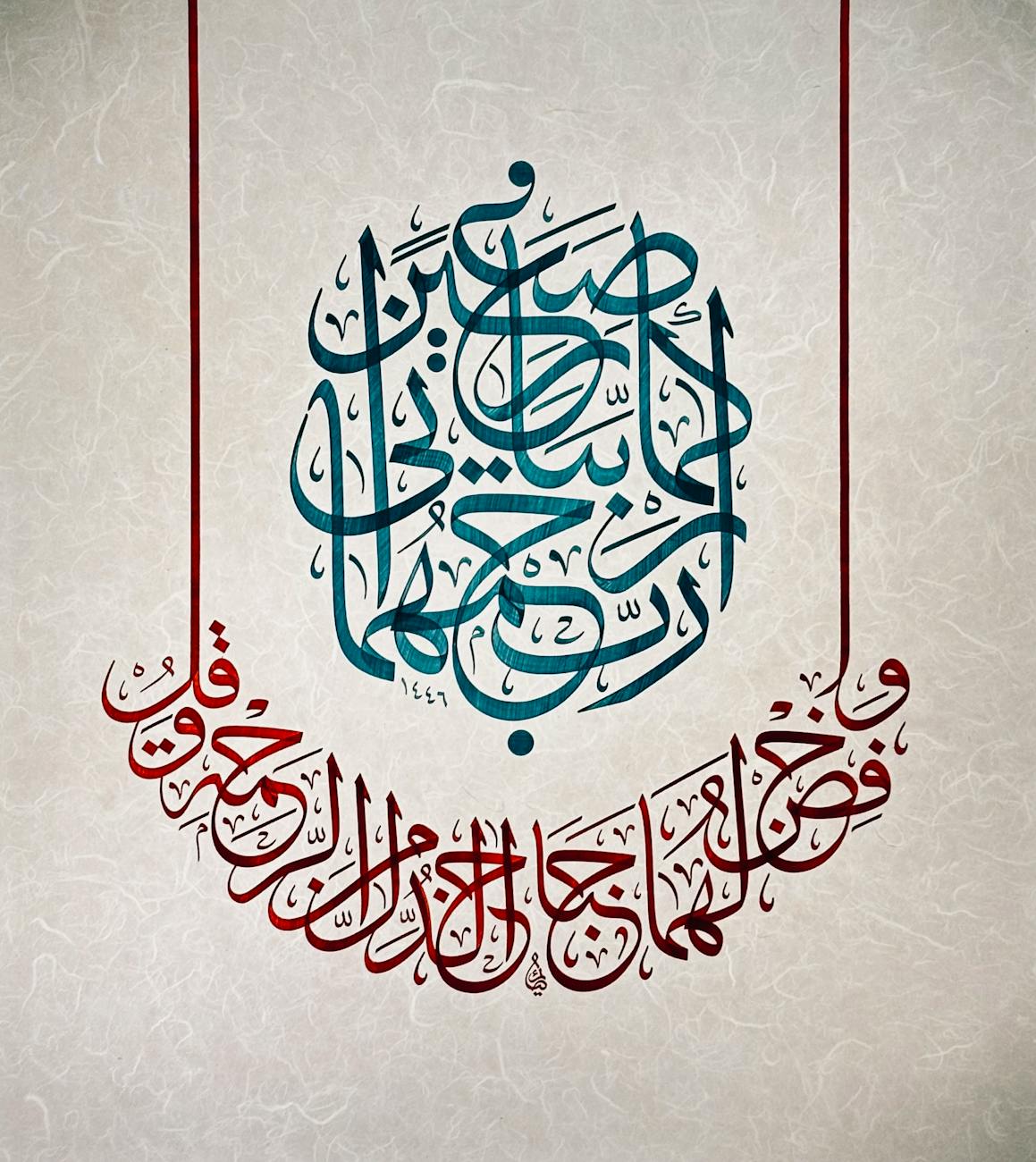
Calligraphy is beautiful, stylized handwriting. In the context of sacred art, it is much more than neat penmanship. Letters themselves become visual forms. Writing can be arranged, shaped, and designed so that language carries both meaning and beauty at the same time.
This helps explain why calligraphy holds such power in Islamic religious art. If living beings are avoided in religious contexts, then script can become a central artistic vehicle for devotion. The written form is not merely read; it is seen. Curves, spacing, balance, and flow all contribute to an impression of order and reverence.
This is one of the remarkable things about the arts more broadly: they often blur the line between function and beauty. Writing is practical. Art is expressive. Calligraphy unites both. It is language transformed into sacred design.
Geometrical designs: devotion through pattern
Geometrical designs are patterns built from precise shapes such as circles, lines, stars, and repeated forms. They rely on order, repetition, and structure. In sacred art, these designs can create a sense of harmony and concentration.
Because geometry is based on relation and proportion, it can fill a surface without needing a narrative scene or human figure. The result is often immersive. Instead of following the expression on a face or the action in a story, the viewer encounters rhythm, balance, and repetition.
This kind of design also shows a wider truth about visual art: art does not need to depict a person or event to communicate something profound. The visual arts include many different methods of expression, from drawing and painting to architecture and sculpture, and they are constantly open to redefinition. In some traditions, a sacred message is carried best by image. In others, by pattern and script.
Why it looks so distinct from other traditions
Islamic sacred art becomes even more interesting when placed alongside other historical styles.
Ancient Roman art depicted gods as idealized humans, shown with distinguishing features. In that tradition, divinity could be communicated through a perfected human form. A figure might be presented with beauty, poise, and symbolic attributes, making the body itself a bearer of meaning.
By contrast, Byzantine and Gothic art in the Middle Ages were shaped by the dominant church and expressed Christian themes. Here again, sacred art worked through imagery tied to religious subjects.
Many Asian artistic traditions, meanwhile, often worked in a style similar to Western medieval art in one important respect: a concentration on surface patterning and local colour. Local colour means the natural, flat color of an object without shading. In this approach, areas of color are defined by outlines, emphasizing the surface and pattern of the image rather than creating deep illusionistic space.
Seen against these examples, Islamic sacred art stands out clearly. Where Roman art might idealize the human body, and Byzantine or Gothic traditions might foreground Christian subjects, Islamic religious art often turns away from living figures and toward visual systems made of script and geometry.
The power of surface, outline, and order
It is easy to underestimate pattern because it can seem decorative. But decoration in art is not automatically superficial. Surface treatment, outlining, and repeated design can carry deep cultural and spiritual meaning.
The broader history of art shows that style is never just style. Ancient Greek art, for example, developed skills to show musculature, poise, beauty, and anatomically correct proportions. That tells us something about what that culture valued visually. Medieval Christian art’s focus on Christian themes tells us something else. The concentration on pattern and local colour in many Asian arts reveals another way of organizing visual attention.
Islamic sacred art belongs in that same conversation. Its use of calligraphy and geometrical design is not simply a fallback because figures are absent. It is a deliberate artistic mode. It makes the surface of an object or building meaningful. It invites the eye to move across lines, shapes, and written forms. In doing so, it turns visual order into a carrier of devotion.
Sacred art is more than pictures
One reason this topic matters is that many people casually equate art with pictures of things. But the arts are much broader than that. They include visual arts, literature, and performing arts. Even within the visual arts, expression can happen through architecture, design, drawing, painting, photography, sculpture, and more.
That broader definition helps us better appreciate Islamic sacred art. If art is understood only as imitation or representation, then non-figurative religious art can seem unusual. But if art is understood as creative expression that transmits values, impressions, judgments, ideas, and spiritual meanings, then calligraphy and geometry fit naturally within the deepest purposes of art.
In fact, the arts have always been capable of both producing objects and conveying insights. They can preserve experiences across time and space. Sacred design does exactly that. It shapes a space, guides a mood, and gives visible form to religious thought.
When writing, design, and architecture come together
Islamic sacred art also reminds us that artistic disciplines often overlap. The arts are not always discrete and self-contained. They can combine and interweave with one another. A written form can become a visual composition. A visual pattern can shape an architectural environment. A decorative scheme can also function as a religious statement.
This blending of forms is common throughout the arts. Comics combine artwork with the written word. Opera unites sets, costumes, acting, a libretto, singers, and an orchestra into a single experience. Performance art can merge objects, actions, and audience participation. Art constantly crosses its own boundaries.
Calligraphy and geometrical design show a similar fusion. Writing becomes image. Ornament becomes meaning. Structure becomes devotion. The result is an art that may appear restrained at first glance but reveals immense richness the longer you look.
Different traditions, different choices
No single artistic tradition owns the sacred. Human societies have developed many ways of making belief visible. Some traditions emphasize idealized human forms. Others foreground religious stories. Others still focus on pattern, color, symbol, or text.
That diversity is part of what makes the arts so enduring. They are both dynamic and constant in human life. They change across generations and civilizations, yet they remain one of the primary ways people express who they are and what they value.
Islamic sacred art is a powerful example of that principle. By avoiding the depiction of living beings in religious contexts and turning instead to calligraphy and geometrical designs, it creates a visual world where words and patterns carry devotion. Shape, line, and script do the spiritual work that figures perform elsewhere.
The lasting result: sacred design without figures
So where are the figures? In Islamic religious art, they are often deliberately absent. But the sacred is still fully present.
It appears in stylized writing that transforms language into beauty. It appears in geometrical designs that organize space with precision and harmony. It appears in the way the arts can communicate spiritual meaning without relying on images of living beings.
That is what gives Islamic sacred art its distinctive force. It shows that devotion can be built not only through faces and bodies, but through words, order, and pattern. In this tradition, sacred design is not a substitute for imagery. It is its own profound artistic answer.
Sources
Based on information from The arts.
More like this
Trace the patterns of human creativity — download DeepSwipe and turn every swipe into a little work of art.


