Full article · 7 min read
Supernovae as Cosmic Yardsticks
A star exploding might sound like chaos, but some of these blasts are among astronomy’s most dependable measuring tools. In particular, Type Ia supernovae have become crucial for mapping enormous distances across space. Their value comes from a remarkable combination of violence and consistency: they are extraordinarily bright, visible across vast reaches of the universe, and normal examples tend to reach nearly the same peak luminosity.
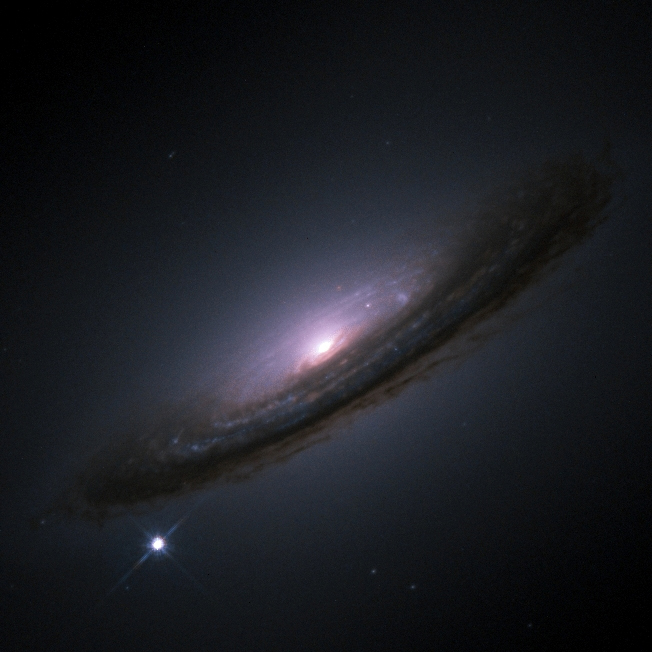
That makes them useful as “standard candles,” a term for objects whose true brightness is known well enough that astronomers can infer distance by comparing how bright they appear from Earth. In the case of normal Type Ia supernovae, the peak absolute magnitude is about −19.3, or roughly 5 billion times brighter than the Sun. For a brief time, a single exploding white dwarf can rival the light of a galaxy.
What Type Ia supernovae actually are
A Type Ia supernova is linked to a white dwarf in a binary star system. A white dwarf is the compact leftover core of a star, and in this case it is typically made mostly of carbon and oxygen. The basic idea is that the white dwarf gains material until conditions become extreme enough to ignite carbon fusion. Instead of a stable burn, the fusion runs away, releasing enough energy within seconds to disrupt the star.
The exact route to the explosion is still not fully settled. One possibility is accretion, where the white dwarf pulls matter from a companion star. Another is the merger of two white dwarfs. In either case, the end result can be a thermonuclear explosion that tears the star apart.
This is very different from the other main supernova mechanism, core collapse, which happens when a massive star can no longer support its core against gravity. Type Ia events are not the deaths of giant stars with intact outer layers; they are explosions of degenerate white dwarfs triggered into runaway nuclear fusion.
Why astronomers trust them
Type Ia supernovae are especially valuable because normal examples have very uniform properties. That does not mean every single event is identical, but it does mean their light output is consistent enough to be calibrated. This consistency is the foundation of their role as distance indicators.
Their light curves are a big part of the story. A light curve is simply a graph of brightness over time. Type Ia light curves have a characteristic shape: a bright peak followed by a relatively steep decline. Because astronomers can compare these curves and apply calibrations for small differences, Type Ia supernovae become practical tools for measuring distances to their host galaxies.
This reliability is tied to the nature of the exploding star. Normal Type Ia supernovae are thought to arise from a consistent kind of progenitor and explode under broadly similar conditions, which helps explain why their peak brightness clusters so closely around the same value.
The radioactive glow: nickel-56 and cobalt-56
The brilliant light from a Type Ia supernova is not powered only by the initial blast. Much of the visible glow that follows comes from radioactive decay in the expanding debris.
A large amount of nickel-56 is created in the explosion. Nickel-56 is radioactive, and it decays into cobalt-56, which later decays into iron-56. These decays release energy, including gamma rays, which heat the ejected material. That hot material then radiates the optical light astronomers observe.
This is why the post-explosion brightening and fading can be modeled so effectively. The light curve is shaped by the decay chain from nickel-56 to cobalt-56 to iron-56, together with how the expanding material changes in transparency over time. In short, the same nuclear physics that powers the glow also helps make Type Ia supernovae predictable.
Measuring distance with brightness
The logic of using a standard candle is straightforward. If an object’s true luminosity is known, and it appears dimmer than expected, it must be farther away. Type Ia supernovae are bright enough to be seen across intergalactic distances, making them ideal for this job.
Astronomers compare the observed brightness of a Type Ia supernova with its expected peak luminosity. That comparison yields distance. Repeating this for many supernovae in many galaxies allows researchers to build up a map of the universe on scales far beyond what nearby stellar measurements can provide.
This is where the term distance–redshift relation becomes important. Redshift is the shift in light toward longer wavelengths caused by the expansion of the universe. More distant galaxies generally show greater redshift. By combining a supernova’s measured distance with the redshift of its host galaxy, astronomers can chart how cosmic expansion behaves across space.
The dim surprise that changed cosmology
One of the most striking results from supernova observations came when some very distant supernovae appeared dimmer than expected. Since dimmer standard candles imply greater distance, this meant those objects were farther away than simple expectations suggested.
That result supported the view that the expansion of the universe is accelerating. In other words, space is not merely expanding; the expansion is speeding up over time. This made Type Ia supernovae central not just to distance measurement, but to one of the biggest discoveries in modern cosmology.
The importance of this finding rests on the special role of Type Ia supernovae: without a class of explosions bright enough, common enough, and uniform enough to compare across huge distances, this pattern would have been far harder to detect.
Light curves, spectra, and how surveys build a cosmic map
To use Type Ia supernovae well, astronomers need more than a single snapshot. They need repeated observations over time to trace the light curve, especially near peak brightness. That is why supernova search programs regularly monitor large numbers of galaxies.
Today, amateur and professional astronomers together discover large numbers of supernovae every year. Computer-controlled telescopes and CCD detectors have greatly expanded the pace of discovery. Survey programs assemble light curves, astrometry, pre-supernova observations, and spectra into large collections that allow careful comparison across many events.
These observations support Hubble diagrams, which plot distance against redshift for galaxies. Low-redshift supernovae help anchor the nearby end of the relation, while high-redshift supernovae extend it deep into the universe. High-redshift means large redshift, typically associated with great distance and earlier cosmic times.
Large modern compilations show just how extensive this work has become. One major data set assembled in 2018 included 1048 supernovae, and by 2021 it had expanded to 1701 light curves for 1550 supernovae from 18 different surveys. That rapid growth reflects how important supernova measurements have become for testing cosmological models.
Why early discovery matters
A supernova is most useful as a distance marker when astronomers can observe it before or near its maximum brightness. If it is found too late, the peak must be reconstructed less directly. That is why discovery programs try to catch these events as early as possible.
Because supernovae in other galaxies cannot be predicted with meaningful accuracy, searches involve repeatedly imaging many galaxies and comparing new images with earlier ones. This has been an area where amateur astronomers have also played an important role, especially by watching nearby galaxies and spotting new points of light that were not there before.
Early observations also reveal details about the explosion physics itself. In some cases, astronomers have managed to record a supernova within hours of detonation, offering rare insight into the first moments of the event.
Not every Type Ia is perfectly standard
Although normal Type Ia supernovae are highly useful, there are exceptions. Some are unusually bright, some are sub-luminous, and some have broadened light curves. Because of this, calibrations are needed to account for variations in brightness linked to light-curve shape or spectrum.
There are also alternative scenarios, such as white dwarf mergers, that may produce a less luminous light curve than more normal Type Ia events. This is why astronomers distinguish between normal and non-standard cases rather than assuming every Type Ia explosion is identical.
Even with these complications, Type Ia supernovae remain among the best distance indicators available over intergalactic scales. Their strength lies not in perfect sameness, but in predictable behavior that can be measured and corrected.
A brief flash with lasting impact
Supernovae are fleeting on human timescales, brightening and fading over weeks or months, yet they have transformed how astronomers understand the cosmos. Type Ia supernovae, in particular, turned exploding white dwarfs into precision tools for measuring the universe.
Their near-uniform peak brightness, their characteristic light curves, and the radioactive decay of nickel-56 and cobalt-56 together make them powerful cosmic yardsticks. By tracking thousands of these explosions and comparing distance with redshift, astronomers have built one of the clearest observational pictures of cosmic expansion—and uncovered evidence that the universe is accelerating.
A dying star, paradoxically, helps reveal the shape and history of everything beyond it.
Sources
Based on information from Supernova.
Measure your curiosity in supernova-sized leaps — download DeepSwipe and explore the universe one bright idea at a time.