Full article · 8 min read
Oceania’s Ancient DNA: Two Waves and a Ghost in the Genome
Oceania holds one of humanity’s most remarkable migration stories. Across Australia, New Guinea, Melanesia, Micronesia, and Polynesia, ancient journeys left traces not only in languages and cultures, but also in DNA. Those traces reveal a peopling shaped by two major waves of migration, deep isolation across islands, and even genetic contributions from an extinct human relative: the Denisovans.
This is what makes Oceania so fascinating. Its human history is not a simple tale of one migration spreading everywhere. Instead, it is a layered record of movement, mixture, and survival across vast ocean spaces.
A region built by voyages
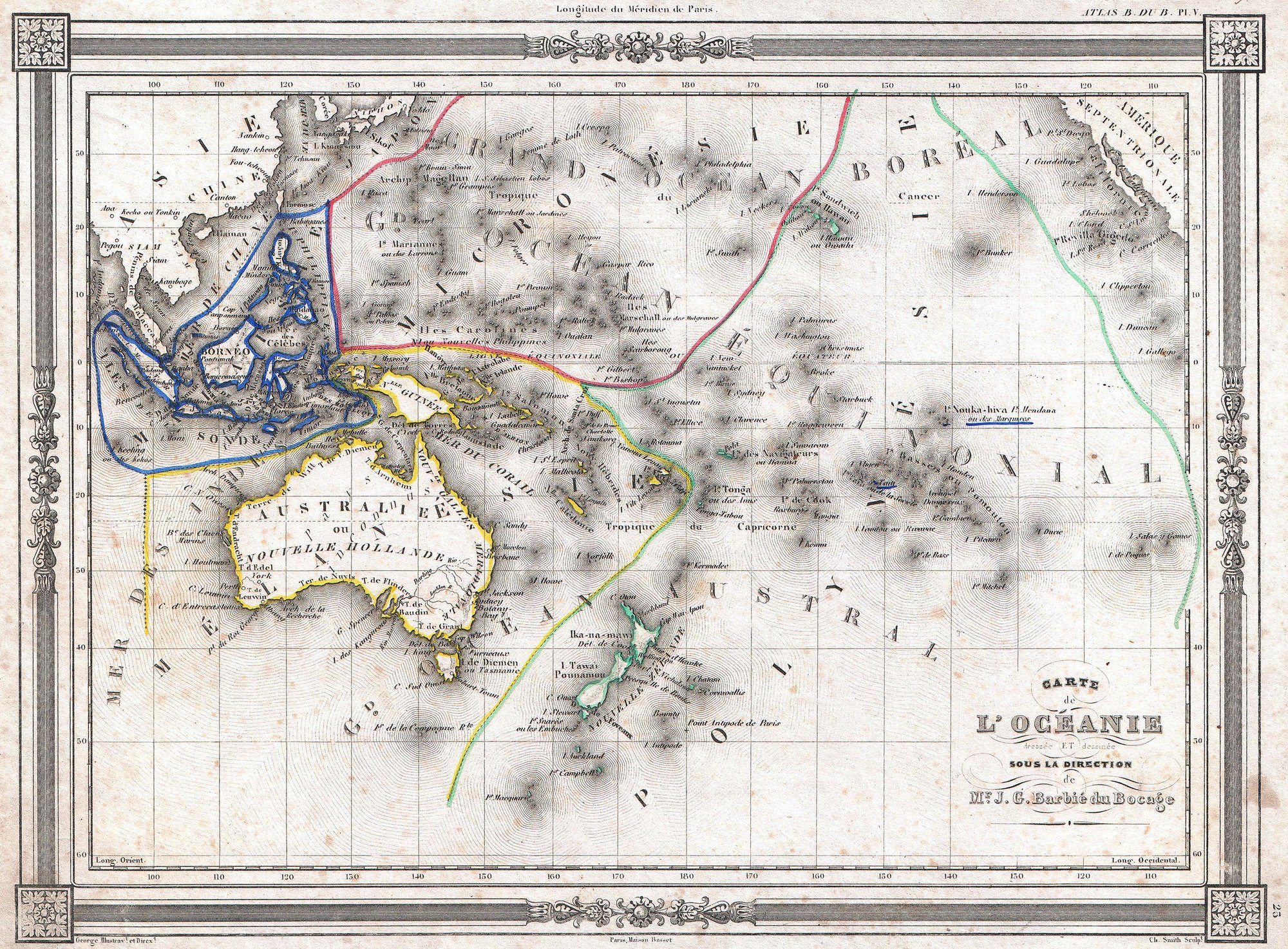
Oceania is a geographical region that includes Australasia, Melanesia, Micronesia, and Polynesia. It stretches across enormous distances, but its islands are linked by the ocean rather than divided by it. That setting matters when thinking about human settlement: every major movement into and across this region required adaptation, navigation, and persistence.
The first settlers of Australia, New Guinea, and the large islands just to the east arrived more than 60,000 years ago. In Australia, Indigenous Australians are described as among the earliest human migrations out of Africa. They are the original inhabitants of the Australian continent and nearby islands, with arrival in Australia placed at about 50,000 years ago. They reached Tasmania about 40,000 years ago by crossing a land bridge that existed during the last ice age, when Australia and New Guinea formed part of the Sahul continent.
That makes Oceania central to understanding early human expansion. Far from being a late-settled fringe of the world, parts of Oceania preserve evidence of some of the oldest long-distance human movements.
The first great wave: Australo-Melanesian settlement
Archaeogenetic research summarized for Oceania describes two major waves of migration. The first was the movement of Australo-Melanesians between about 40,000 and 80,000 years ago. These migrants, identified with Papuans in later genetic studies, colonized much of Near Oceania.
Near Oceania refers to the western island zone that includes New Guinea, the Bismarck Archipelago, and most of the Solomon Islands. It is called “near” not because the islands are small, but because they lie relatively close to one another and to New Guinea compared with the more distant islands farther east.
The article notes that the original inhabitants of the islands now called Melanesia were likely the ancestors of present-day Papuan-speaking peoples. Migrating from Southeast Asia, they appear to have occupied islands as far east as the main islands of the Solomon Islands archipelago, including Makira and perhaps smaller islands farther east.
This first wave established an extremely deep human presence in the region. In genetic terms, some Papuan-related lineages are described as autochthonous haplogroups. “Autochthonous” means native to a place; “haplogroups” are broad genetic lineages traced through inherited DNA. These lineages support the idea of a very long history in Near Oceania, with some suggesting a time depth of 60,000 years.
Denisovan DNA: the ghost in Melanesian genomes
One of the most striking facts in Oceania’s ancient DNA story is the presence of Denisovan ancestry in Melanesians. Denisovans were an ancient human species identified in 2010 from DNA and fossil remains. They are extinct, but their genetic legacy survives.
The article states that an estimated 4% to 6% of the genome in Melanesians, such as Papua New Guineans and people from Bougainville Island, derives from Denisovans. By contrast, no Eurasians or Africans were described there as showing contributions of Denisovan genes.
That makes Melanesian DNA especially important for reconstructing ancient human history. It preserves evidence of interaction between modern humans and another ancient human group. In other words, the Denisovans are a “ghost” population in the sense that they no longer exist as a living people, yet part of their biological history is still present in living genomes.
This also helps explain why Oceania is so often at the center of archaeogenetic research. Its populations do not just reflect migration routes; they also preserve clues to encounters that happened tens of thousands of years ago.
The second great wave: Austronesian expansion
The second major migration wave came much later. About 3,500 years ago, Austronesian speakers arrived in Near Oceania and their descendants spread into Remote Oceania.
Austronesian refers to a vast language family. In Oceania, it includes many of the languages that later spread across island Southeast Asia and much of the Pacific. According to the article, Polynesian people are considered a subset of the sea-migrating Austronesian peoples, and tracing Polynesian languages places their prehistoric origins in the Malay Archipelago and ultimately in Taiwan.
Between about 3000 and 1000 BCE, speakers of Austronesian languages spread from Taiwan into Island Southeast Asia, then to the edges of western Micronesia and onward into Melanesia. By roughly 1400 BCE, the Lapita people, named after their pottery tradition, appeared in the Bismarck Archipelago of northwestern Melanesia. In the archaeological record, these traces help researchers follow the path of this expansion.
In simpler terms, the first major settlers of Near Oceania were there long before the Austronesian-speaking expansion reached the region. When that later movement arrived, it did not enter an empty world. It encountered existing populations with deep roots in the islands.
Contact, mixing, and complexity
What happened when Austronesian-speaking arrivals met Papuan-speaking populations? The picture is not one of simple replacement. The article describes contact along the north coast of New Guinea and on islands north and east of New Guinea, where Austronesian peoples came into contact with pre-existing Papuan-speaking communities.
Some late 20th-century scholars proposed a long period of interaction that produced complex changes in genetics, languages, and culture among these peoples. That is a crucial point. Human history in Oceania is not just about one migration after another; it is also about mixture and exchange.
The archaeogenetics section reinforces this. Mitochondrial DNA studies, which follow inherited maternal lines, quantify the scale of the Austronesian expansion and show a homogenising effect. “Homogenising” here means that the spread of these populations created shared genetic signals over wide areas, even while older local lineages remained in place.
So the ancient DNA story of Oceania is layered. Deep Papuan ancestry remains strong in Near Oceania. Austronesian-speaking populations expanded later and spread widely. In many places, the result was not either-or, but both.
Santa Cruz and the island puzzle
One of the strangest pieces in this story comes from Santa Cruz. This population lies in Remote Oceania, the more recently settled island world beyond Near Oceania. Yet genetically, Santa Cruz is described as an anomaly.
An anomaly is something that does not fit the pattern researchers expected. In this case, Santa Cruz shows extreme frequencies of autochthonous haplogroups of Near Oceanian origin. Put more simply, it has unusually high levels of genetic lineages associated with the older populations of Near Oceania.
That is surprising because Santa Cruz is in Remote Oceania, where the later Austronesian expansion played a major role in settlement. Its genetic profile suggests a more complicated population history than a straightforward eastward spread. This is exactly the kind of puzzle that keeps Oceania at the forefront of migration research: the islands do not all tell the same story.
Why Australia matters so much
The story of early Oceania is impossible to tell without Australia. Indigenous Australians are identified as among the earliest humans to leave Africa, and they reached Australia around 50,000 years ago. The earliest definite human remains found in Australia are those of Mungo Man, dated to about 40,000 years old.
Australia’s settlement shows that early humans were capable of reaching and occupying distant lands far earlier than many people assume. The article also notes that although Indigenous Australians likely migrated through Southeast Asia, they are not demonstrably related to any known Asian or Polynesian population. There is evidence of genetic and linguistic interchange in the far north with Austronesian peoples of modern New Guinea and nearby islands, but this may reflect more recent trade and intermarriage.
That deep history gives Australia a special place in the larger Oceanian picture. It represents not only ancient migration, but also one of the earliest and longest continuous human presences in the region.
DNA, language, and archaeology together
No single type of evidence explains Oceania on its own. Archaeology uncovers settlement traces and material culture like Lapita pottery. Linguistics follows the spread and relationships of language families such as Austronesian and Papuan. Genetics reveals ancestry, admixture, and deep lineages.
The article makes clear that these lines of evidence often reinforce one another. Two major migration waves appear in genetic studies. Linguistic evidence traces Polynesian origins through Austronesian languages. Archaeology identifies well-defined traces of expansion through the Pacific. Together, they turn the peopling of Oceania into one of the clearest examples of how multiple sciences can be combined to reconstruct the human past.
And yet mysteries remain. Micronesia, for example, has competing theories about the origin and arrival of its first settlers, with archaeological work complicated by island size, storm damage, and settlement patterns. Large areas of New Guinea remain poorly studied by scientists and anthropologists because of mountainous terrain and extensive deforestation. Some indigenous groups in Papua New Guinea and in the Indonesian provinces of Papua and West Papua have had very little outside contact.
That means the story is still incomplete. Oceania’s ancient DNA record already reveals extraordinary journeys, but future work may still change the map.
A human logbook written in genes
Oceania’s settlement history reads like a record of epic movement: very early humans entering Australia and New Guinea, Papuan-related populations shaping Near Oceania for tens of millennia, Austronesian-speaking voyagers expanding into new islands around 3,500 years ago, and oddities like Santa Cruz preserving unexpected ancestral signatures.
Add Denisovan ancestry in Melanesians, and the picture becomes even more remarkable. Oceania is not only a story of islands and oceans. It is a story of ancient encounters, survival across immense distances, and populations whose DNA still carries the imprint of some of humanity’s boldest migrations.
If you want to see how deep history can survive inside living people, Oceania is one of the most compelling places on Earth to look.
Sources
Based on information from Oceania.
Trace humanity’s wildest journeys one swipe at a time — download DeepSwipe and explore the world’s hidden stories daily.


